.jpeg)
Training That Sticks: Why Raven Runs Scenarios

You don't rise to the occasion. You fall to the level of your training. Every operator, medic, and protector who's ever worked a real incident knows the second half of that sentence is the one that matters — because when the adrenaline hits, the slideshow you sat through last spring is the first thing your brain throws overboard.
That's why scenario-based training is at the core of everything we do at Raven Strategic Group. We believe in training so deeply that we made it one of the three foundational pillars of the firm, alongside Consulting and Operations. It's the thing that holds up when everything else is on fire. Literally, sometimes.

Stress inoculation, in plain English
There's a clinical term for what good scenario training does to a person: stress inoculation. The idea is simple. Expose someone to a controlled dose of the thing that would otherwise overwhelm them — chaos, time pressure, sensory overload, the sight of blood, the sound of a raised voice — and the body and brain learn to function through it instead of locking up around it. Done right, repeated controlled exposure builds psychological calluses; the same trigger that used to spike the heart rate and tunnel the vision shows up later and the trained person just... works through it.
The research backs this up across every profession that has to perform under pressure. Officers trained in dynamic, scenario-based environments recall protocols roughly 40% better under simulated stress than those trained by lecture. First responders who practice under simulated stress build muscle memory that remains accessible even when adrenaline floods the system. The mechanism is the same whether we're talking about a SWAT entry, a CPR save in a parking lot, or a parent guiding a child to cover at a youth event.
In plain English: you cannot read your way to a good outcome on a bad day. You have to rehearse the bad day.

Identifying your stressors before they identify you
One of the most useful things we do in a scenario is also the simplest — we watch.
Everyone has stressors. Crowded rooms. Specific sounds. The presence of children. Bad lighting. Radio chatter. A weapon on the hip of someone who isn't you. The smell of blood. A clock counting down. Most people don't know which of these will spike their heart rate and tunnel their vision until they're already in it, and by then it's too late to learn anything useful.
In a Raven scenario, we surface those stressors on purpose, in a setting where the only consequence of finding them is that you now know they exist. We watch how you breathe. Where your eyes go. What you forget to do. What you do twice. Whether you talk to your team or freeze them out. Then we sit down with you afterward — every scenario ends with an after-action review, because the rep without the review is just exercise — and we walk through what happened, why it happened, and what to do about it next time.
That's the part most "training" never gets to. Reps without feedback build habits, but they don't build the right ones.
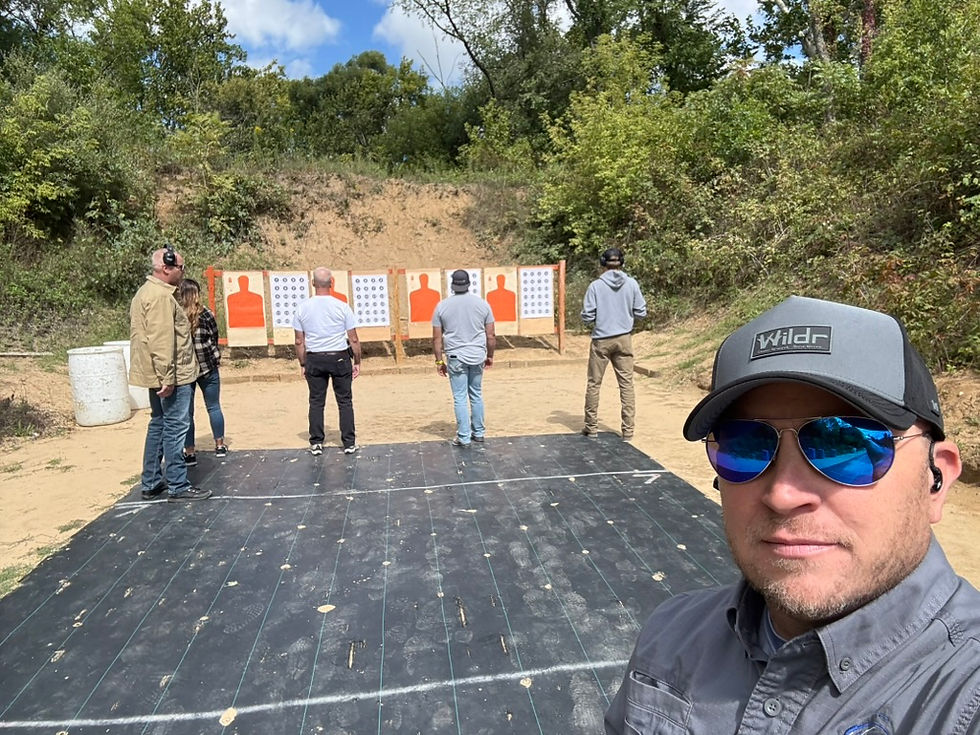
Muscle memory — the good kind, not the bad kind
Here's the thing about muscle memory: it doesn't care whether it's correct.
Your brain will happily wire in a sloppy tourniquet application, a weak weapon presentation, or the habit of stepping toward the threat instead of off the line — and it will hand that exact wiring back to you when the real thing happens. Realistic training using role players, marking rounds, and immersive scenarios embeds decision-making patterns the brain can pull like a file when it needs them. The flip side is just as true: bad reps embed bad files.
So we treat training like a craft. We slow it down before we speed it up. We catch the small errors before they calcify. We use direct instructor feedback to correct bad tendencies the first or second time we see them, not the fiftieth. We let consequences land in training — a marking-round hit, a "patient" who deteriorates because someone skipped a step, a principal who walked into a room nobody had cleared — because a mistake that hurts in training is one that's less likely to be repeated in the field.
The goal isn't to embarrass anyone. The goal is to weed out the habits that would get someone killed and replace them with the ones that won't.


Across the whole platform
This methodology is the connective tissue across everything we teach. A few examples of where we apply it:
Basic medical emergencies. The cardiac arrest in the office break room. The diabetic emergency at the family reunion. The bad cut in the kitchen. Most adults have sat through a CPR class at some point and remember almost none of it. We rehearse the call, the compressions, the AED pads, the bystander management, the handoff to EMS — under time pressure, with distractions, on the actual floor instead of a clean classroom mat.
Disaster and austere medicine. When EMS is 45 minutes away — or not coming — the calculus changes. We run mass-casualty triage, prolonged field care, and improvised-equipment scenarios for teams that travel into regions where the local trauma system is whatever they brought with them. This is the same logic tactical trauma trainers use to build confident, mission-ready responders for austere environments, adapted to civilian and corporate contexts.
Protection — from soft skills to force-on-force. The protection spectrum is wide, and so is our training. On the soft end, we run posture, positioning, and pre-attack-indicator drills for executive protection teams and close-protection details. In the middle, we drill vehicle work, route reactions, and crowd management. On the high end, for teams that need it, we run full force-on-force evolutions with marking rounds — the same reality-based methodology that has produced measurable reductions in use-of-force incidents in law-enforcement programs that adopted it seriously.
Faith communities. Church safety teams are some of the most motivated and most under-trained groups we work with. We build programs that fit the culture of the congregation — discreet, de-escalation-forward, family-aware — and we scale the scenario intensity from tabletop walkthroughs to live evolutions, depending on what the team is ready for.
Schools. Teachers and administrators don't want to be a tactical team, and they shouldn't have to be. We focus on the decisions and actions that are actually theirs — lockdown, reunification, medical response, communication with parents and law enforcement — and we rehearse them in the actual buildings, with the actual radios and the actual sight lines.
Businesses. Workplace violence, active threat, medical emergency, severe weather, evacuation. Most companies have a binder. Fewer have ever run the binder. We run the binder, find out which pages are wrong, and rewrite them with the people who would actually be holding them.
Individuals. This one surprises people. A growing share of our private students aren't security professionals at all — they're parents, executives, travelers, faith leaders, and ordinary folks who just want to know how they'll react when something goes sideways. They come to a controlled environment, run scenarios calibrated to their lives, and walk out knowing things about themselves they didn't know before. That self-knowledge is half the battle.
Controlled chaos, on purpose
The word "controlled" is doing a lot of work in this post, and that's intentional. Scenario-based training only works when the chaos is real enough to teach and safe enough to learn from. That balance doesn't happen by accident. It comes from instructors who know how to read a student, dial the intensity up or down on the fly, stop the scenario when learning has stopped happening, and rebuild the rep so the next one teaches the right lesson.
Every Raven scenario is built backwards from what we want a student to be able to do, feel, and decide on their worst day. We design the inject. We pick the stressors. We rehearse it ourselves first. And every evolution ends the same way — with an honest conversation about what happened, what to keep, and what to change.
People, Protection, Peace of Mind
Training is where the mantra lives or dies. You can't protect people you haven't prepared to protect. You can't deliver peace of mind on the strength of a credential someone earned a decade ago and never used.
If your team — corporate, faith-based, school, or family — has been doing the binder-and-briefing version of training and you're wondering whether it would actually hold up on a bad day, let's have a conversation. We'll come watch what you're doing now, tell you honestly where the gaps are, and build a scenario program around the specific stressors your people would actually face. That's where it starts.


